
Habit trackers, group apps and habit duels compared
Habit apps differ in one thing that matters more than features: what has to happen before a day counts as done. This page compares the four common answers - a checkbox you tick, a shared goal your group ticks, a challenge scored on the honor system, and a duel where a referee rules on proof - and says plainly which one Forge is.
The four approaches
| Approach | Proof required | Who is involved | Strength | Limit |
|---|---|---|---|---|
| Solo habit tracker | None - you tick the box | You, alone | Any habit at all, including private ones. Zero coordination. | The person who benefits from a tick is the person doing the ticking. |
| Shared goal or group app | None - everyone ticks their own box | A group, all pulling the same way | Social pressure and visibility, without competition. | Still self-reported, and a quiet group applies no pressure at all. |
| Honor-system challenge app | Self-reported, sometimes a photo nobody rules on | You against someone else | Competition sharpens attention. | Nothing decides a disputed day, so the loser can always say it did not count. |
| Refereed habit duel (Forge) | A photo, a video up to 60s, or a start and end capture, every day | Two competitors and a referee - a friend or an AI | A third party rules each day, so a day is won, not claimed. | Needs an opponent, and only covers habits you can show on camera. |
When a solo tracker is the better choice
If the habit is private, unphotographable, or something you would rather not turn into a contest, a solo tracker wins and Forge is the wrong tool. The same goes for habits measured in months of quiet consistency rather than daily effort - Forge runs in blocks of 3, 7, 14 or 30 days.
When a refereed duel is the better choice
When you already know what to do and simply do not do it. A duel adds two things a checkbox cannot: someone on the other side who notices a skipped day, and a referee who decides whether the day was actually done. Both of those exist for the same reason - a habit tracker you can lie to is a habit tracker you will lie to.
Where Forge stands specifically
- Proof: a photo, a video of up to 60 seconds, or a start and end capture. Every habit in the library is provable in a minute or less.
- Referee: a third friend, or an AI judge that rules automatically. A friend judge who has not ruled a day by noon the next day is backed up by the AI.
- Stakes: score only. No pot, no wager, no cash prize.
- Length: 7, 14, 21 or 30 days per challenge.
- Price: free to start one 7-day challenge a month; challenges you are invited to are free at any length. Premium is $6.99/month or $39.99/year and unlocks 14-, 21- and 30-day challenges plus five at once, with a 7-day free trial and no card. Lifetime is $99.99 once. Team plans start at $29.99/month for 5 seats.
- Platforms: iOS, Android, macOS, Windows and the web.
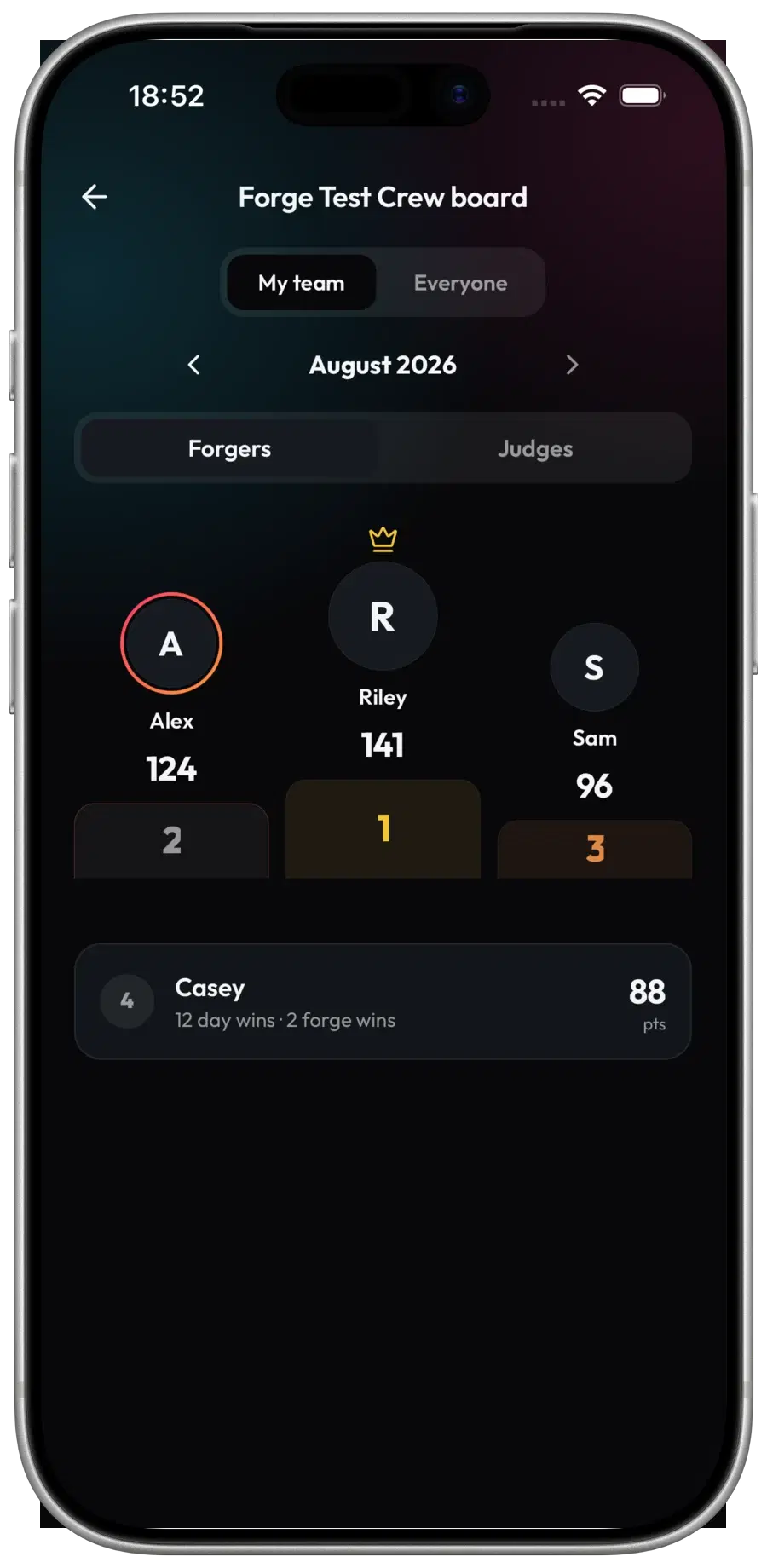
- Not offered: custom habits outside the curated library, negative or abstinence-only tracking with no visible proof, and public shame boards - the monthly board ranks winners only.
The mechanics in full are on the habit duel and habit tracker pages.
Start a forge free
Free to start. If it turns out a solo tracker suits you better, you have lost nothing.